Classification
Privacy & Security Classification
How Data & More, with the help of more than 200,000 people, builds and maintains the world's best privacy and security classification: taxonomies, language models, OCR and ID recognition, wrong 0.003277% of the time.
Classified
28
languages, against local regulation, not translation
- Classify (this page)Decide what the data actually is.
- VerifyVerified by a human before anything happens.
- DeleteBlock, strip, relabel or remove.
Classification walkthrough
The EU set the benchmarks through GDPR and NIS2. Data & More has spent nine years on privacy classification and three on security classification, working with legal teams in more than 28 countries and academic specialists in rare event classification.
The engine
Five layers you can open up and change
Classification ships ready to use. Everything in it is still yours to adjust.
Algorithms
The detectors: pattern, semantic, OCR, face and ID recognition. Each one reports what it found and how confident it is, and each can be switched on or off per company.
Dictionaries and entry types
The vocabulary. Local unions, religious orientations, public certificates, health terms and drug names, per country. Add your own terms where your sector has words the general model does not.
Document classes
What a document is: passport, health information, CV, consent, payment card. A class is how the rest of the platform talks about a finding, from the report to the Purview label.
Tags
What should happen to it. Tags are how a class becomes an action: notify, delete, archive, redact, or leave alone.
Policies
The rules that tie it together. The policy builder composes conditions with AND and OR across class, category, creation date, document age, edited date, file size, duplicates, account and more, with revisions kept so you can see what changed.
Classification
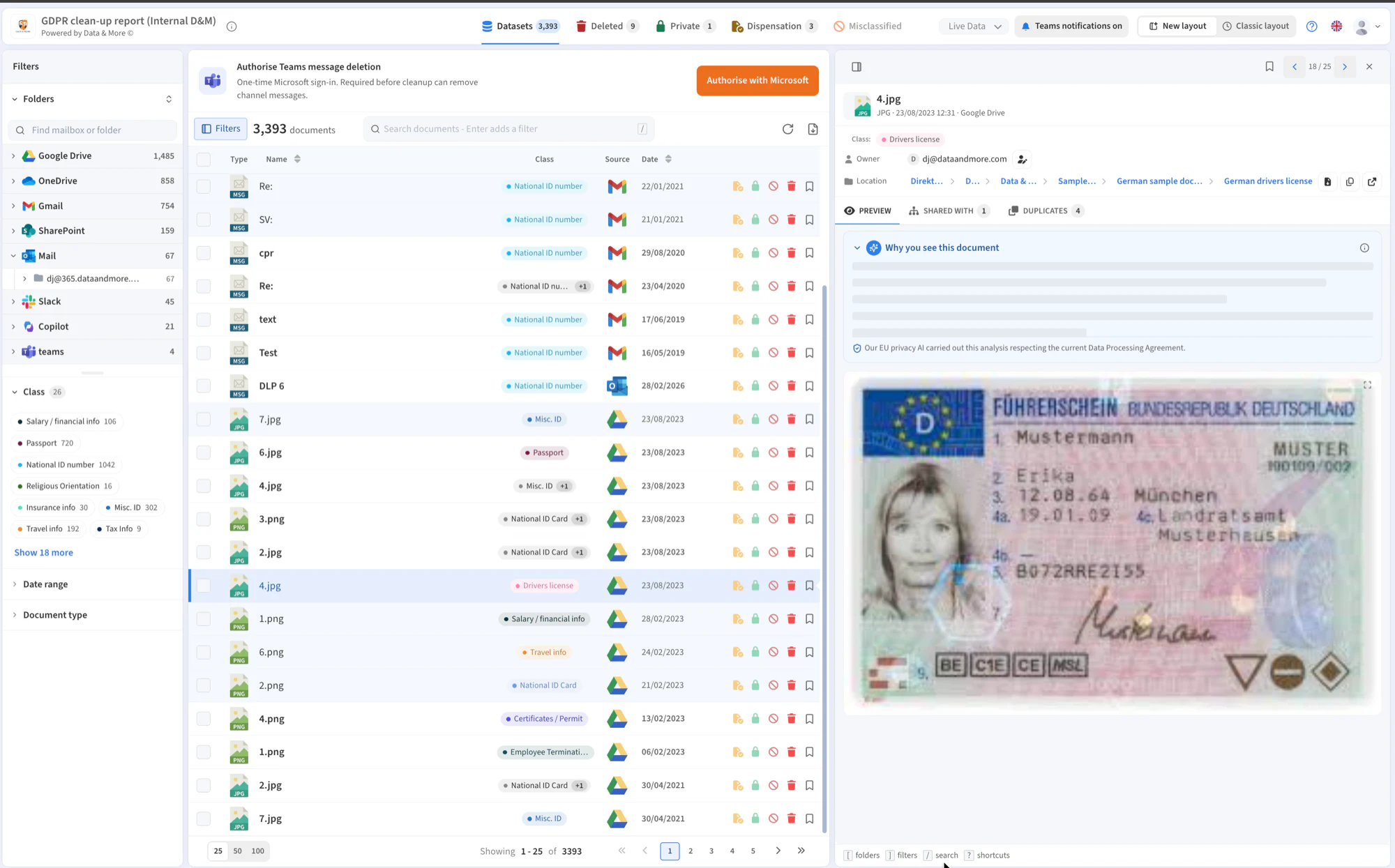
Capability
Why it finds what others miss
Semantics
Meaning, not just patterns
Complete semantic analysis rather than regex and word lists. A sentence about someone's illness is health data even when it contains no diagnosis code.
Languages
28 languages, localised
Not translation: localisation. Country-specific document classes, local unions, local certificates, local health information and drug names, built by a dedicated language team.
Images
OCR, faces and ID documents
A new OCR engine with layout detection and a fast path for passports and ID cards via the machine-readable zone, plus face recognition and a count of how many people are in a picture.
Context
Internal or external
The engine distinguishes internal communication from external, so a policy can treat a CV sent to a colleague differently from the same CV sent out of the building.
Custom
Your own classifications
Organisations with sector-specific data add their own classes and algorithms. Adding a recogniser is a small, contained change, not a product release.
Feedback
It gets better because people correct it
Every Misclassified mark from a data owner comes back as training signal. With more than 200,000 people using the reports, errors surface quickly and get fixed.
Classification
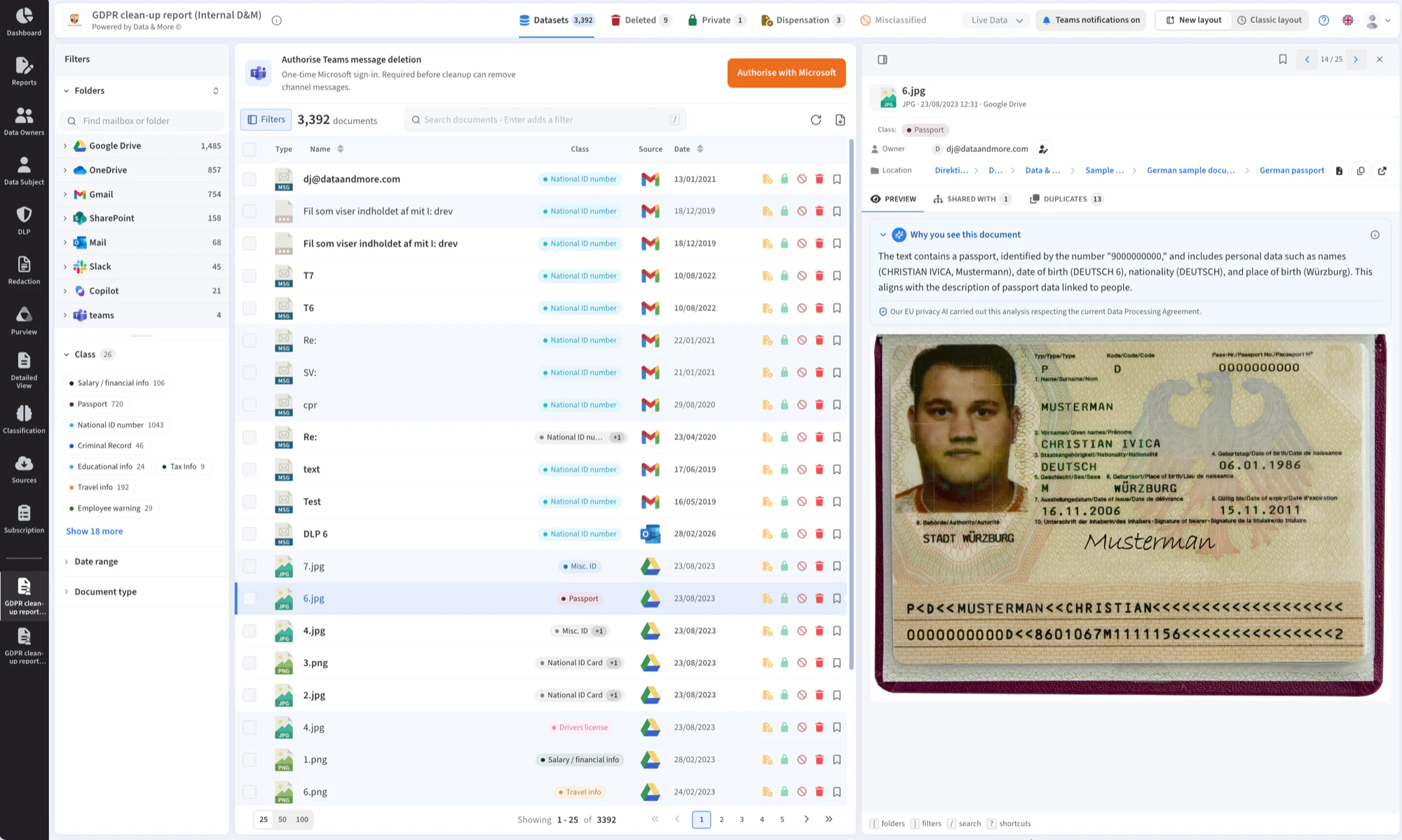
Security classification
Security is a separate question
Privacy classification asks whose data this is. Security classification asks what it would give away.
Different data, different classes
Passwords and secrets, digital certificates, infrastructure configuration, log files, network access control, physical security and security incident reports. None of it is personal data, and a privacy classifier walks straight past it.
Different owner, different report
A GDPR finding goes to the data owner for verification. A leaked private key goes to the CISO, now, and the action is rotation rather than deletion. The DPO gets the notification list; this one is for security.
Different clock
Personal data that should have been deleted is a compliance problem that grows slowly. A credential in a shared mailbox is a live exposure that is either still valid or is not.
Classification
Awaiting capture
The security classification group listing passwords and secrets, digital certificates, infrastructure config, log files, network access control, physical security and security incidents
public/product/classification-security-classes.webp
Security classes
What the security classes look for
Credentials
Passwords and secrets
Credentials pasted into mail, API keys in attachments, service account passwords in onboarding documents and the spreadsheet somebody keeps them in.
Keys
Digital certificates
Private keys and certificates mailed between teams or suppliers, which stay valid long after the thread is forgotten.
Estate
Infrastructure config
Firewall rules, server configuration, network diagrams and access control lists: the map an attacker would otherwise have to build by hand.
Traces
Log files
Logs attached to support threads, which carry internal hostnames, user names, tokens and sometimes the contents of a request.
Physical
Physical security
Door codes, alarm procedures, key-holder lists and site plans, which are rarely treated as data at all.
Incidents
Security incidents
Incident reports and post-mortems, which by their nature describe exactly which weakness was exploited and how.
Proof
Classification in production
28
languages classified
7B
datasets monitored
0.003277%
false positive rate
25
privacy data categories
Questions about classification
How accurate is it, really?+
Do we have to configure it before it is useful?+
What about Microsoft Purview's classifiers?+
Does our data leave our environment?+
What counts as a security risk in a document?+
What does NIS2 have to do with it?+
Should security findings be deleted?+
Is this a DLP tool?+
See it classify your own data
Monitor 250 mail accounts for free. The first report shows what it found, and the security classes run in the same pass.
Start nowNo credit card required.