Reports and deletion
Nothing is deleted until a person says so
This is where the platform stops describing the problem and removes it. The person who owns the data reviews their own findings, decides what goes, and the platform deletes it. Every other vendor stops before this step.
Verifying
350K
data owners decide before anything is deleted
- ClassifyDecide what the data actually is.
- Verify (this page)Let the person who owns it confirm.
- ActBlock, strip, relabel or remove.
Reports
Workflow
How a deletion actually happens
Four steps, and a person stands in the middle of them on purpose.
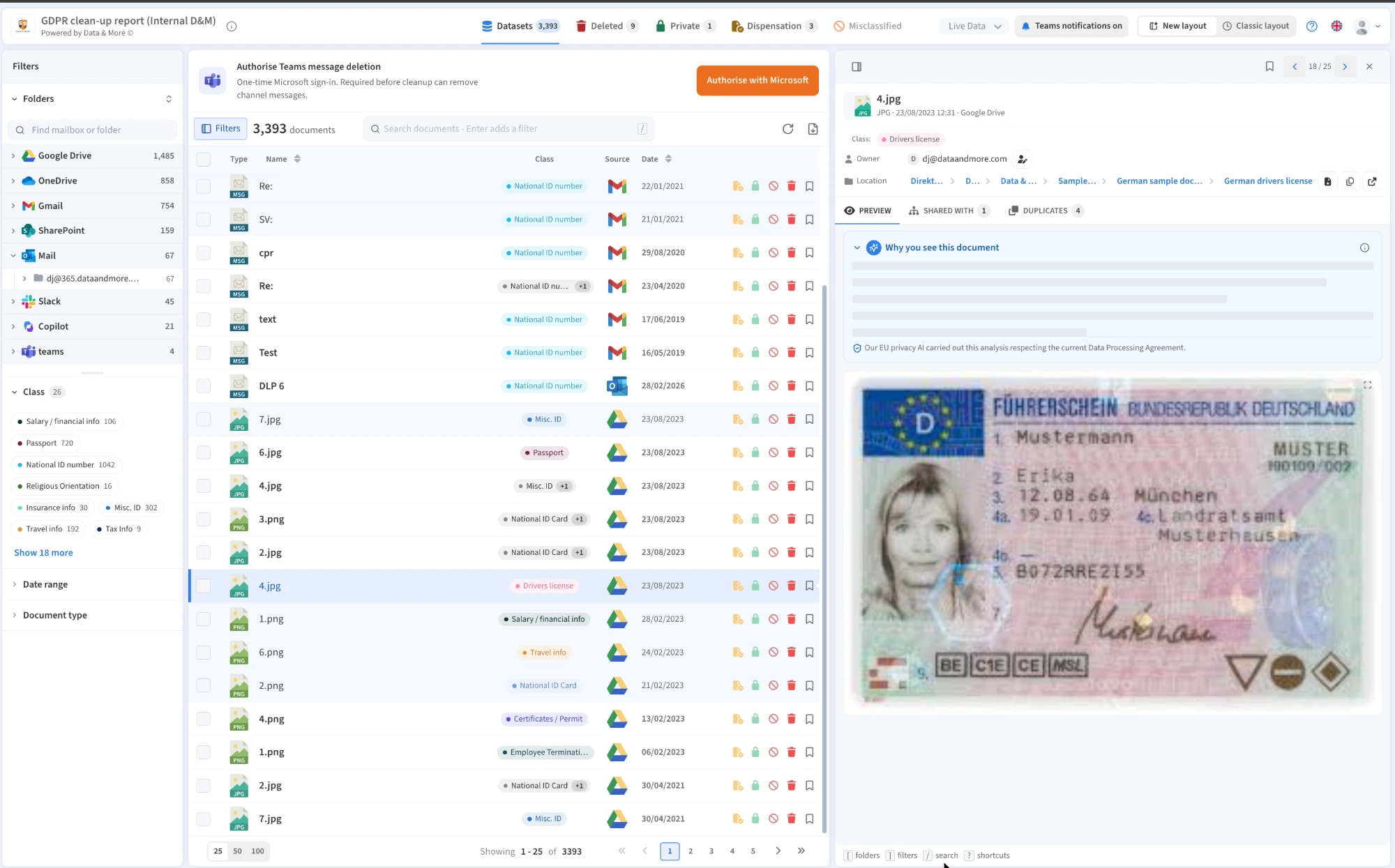
The report reaches the data owner
A notification covering their own non-compliant data, in their own language, behind an Entra or SSO login. Send-outs go by fixed date or by period, every one is tracked and validated, and any can be resent with the original configuration. Exemptions are managed centrally.
The owner decides, not the system
They filter by classification, location, document age, creation and last-access date and file type, preview each document, and select in bulk. Anything that should stay is marked Private, Dispensation or Misclassified, with a mandatory note where you require one.
The platform deletes, moves or archives
Confirmed data is deleted in the repository it lives in. Where deletion is the wrong answer it can be moved within or between sources, or archived into the compliance vault.
The audit trail outlives the data
Every deletion records how it happened, manually, automatically or in-source, where the document was, who owned it and how it was classified. That record is what an auditor reads a year later.
Reports
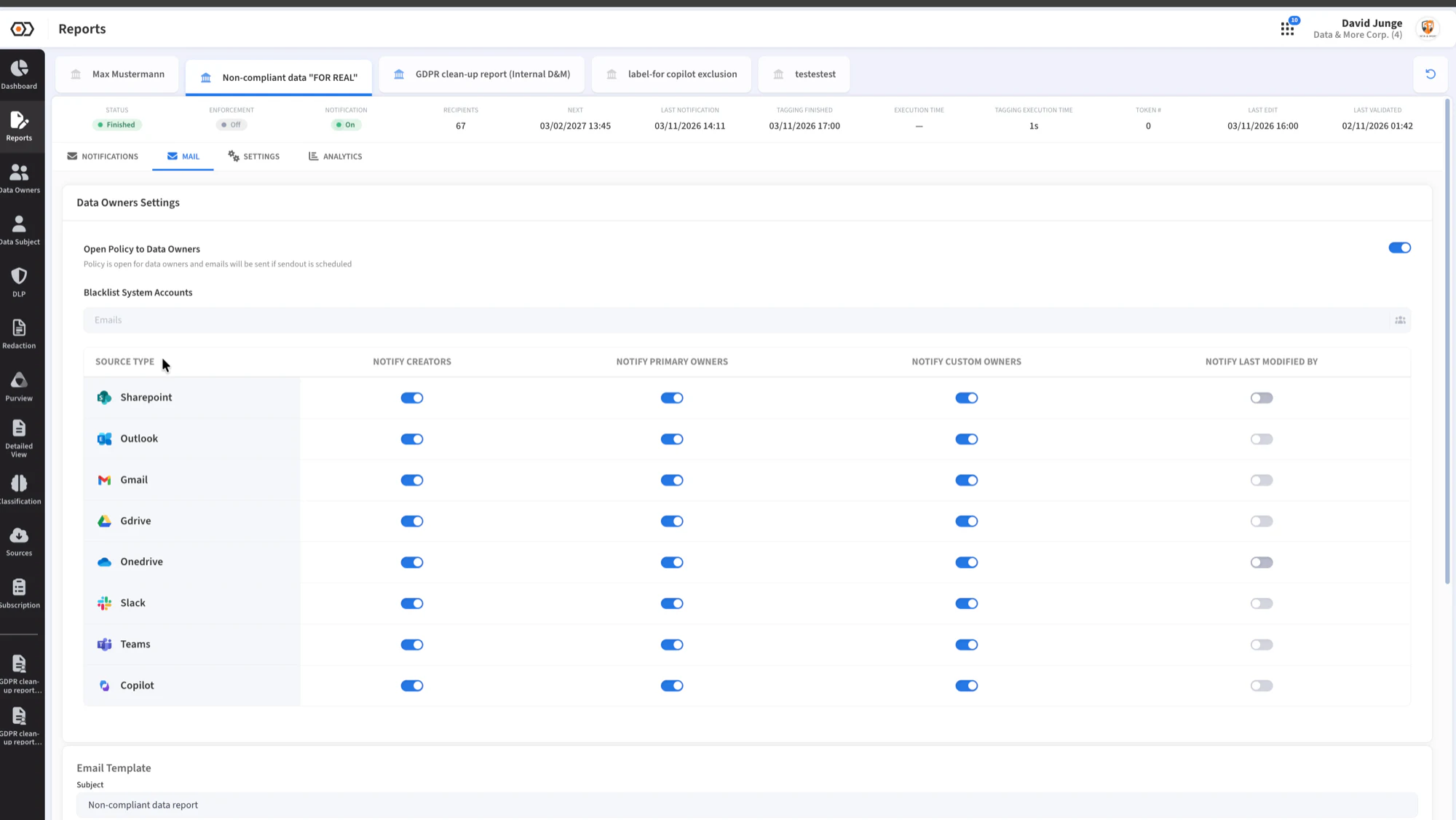
Automation
What you can put on rails
Rules
Automatic deletion
Delete on document age, last access or edit, document class or type, AD group scope, latest verification date or sensitivity label. Your retention policy and the regulatory one run side by side.
Exceptions
What never gets touched
Exceptions on any of the same dimensions, plus the manual Private, Dispensation and Misclassified marks, location and time, folder name and path. Dispensations can be time-limited.
Reversal
Move data back
A send-out that reached wider than intended can be pulled back: data staged for deletion is moved back automatically, before anything is removed.
Report design
The report is yours
Your logo, your header and body text, a help video link, static or rolling cycles, which tabs appear and which notes are mandatory. Usability is the design criterion: fewer than one support case per 1,000 users.
Languages
Every owner in their own language
The report, the classifications and the instructions, in the language the person actually works in.
Proof
Reporting a regulator accepts
Deleted and notified data aggregated by time, user, type and class, with SQL synchronisation for Power BI.
Proof
Deletion in production
7B
datasets monitored
350K
data owners verifying
28
languages classified
0.003277%
false positive rate
Questions about deletion
What exactly gets deleted?+
Is it really deleted, or just hidden?+
What if the classification was wrong?+
Can we run our own retention policy through it?+
Start with your own data
Monitor 250 mail accounts for free and see what a deletion report looks like before anything is deleted.
Start nowNo credit card required.