Classification
What counts as personal data, decided properly
A regular expression finds a number that looks like a passport. It cannot tell you the document is a passport, in Polish, photographed at an angle. Classification combines taxonomies, language models, OCR and ID recognition, and is wrong 0.003277% of the time.
Classified
28
languages, against local regulation, not translation
- Classify (this page)Decide what the data actually is.
- VerifyLet the person who owns it confirm.
- ActBlock, strip, relabel or remove.
Classification
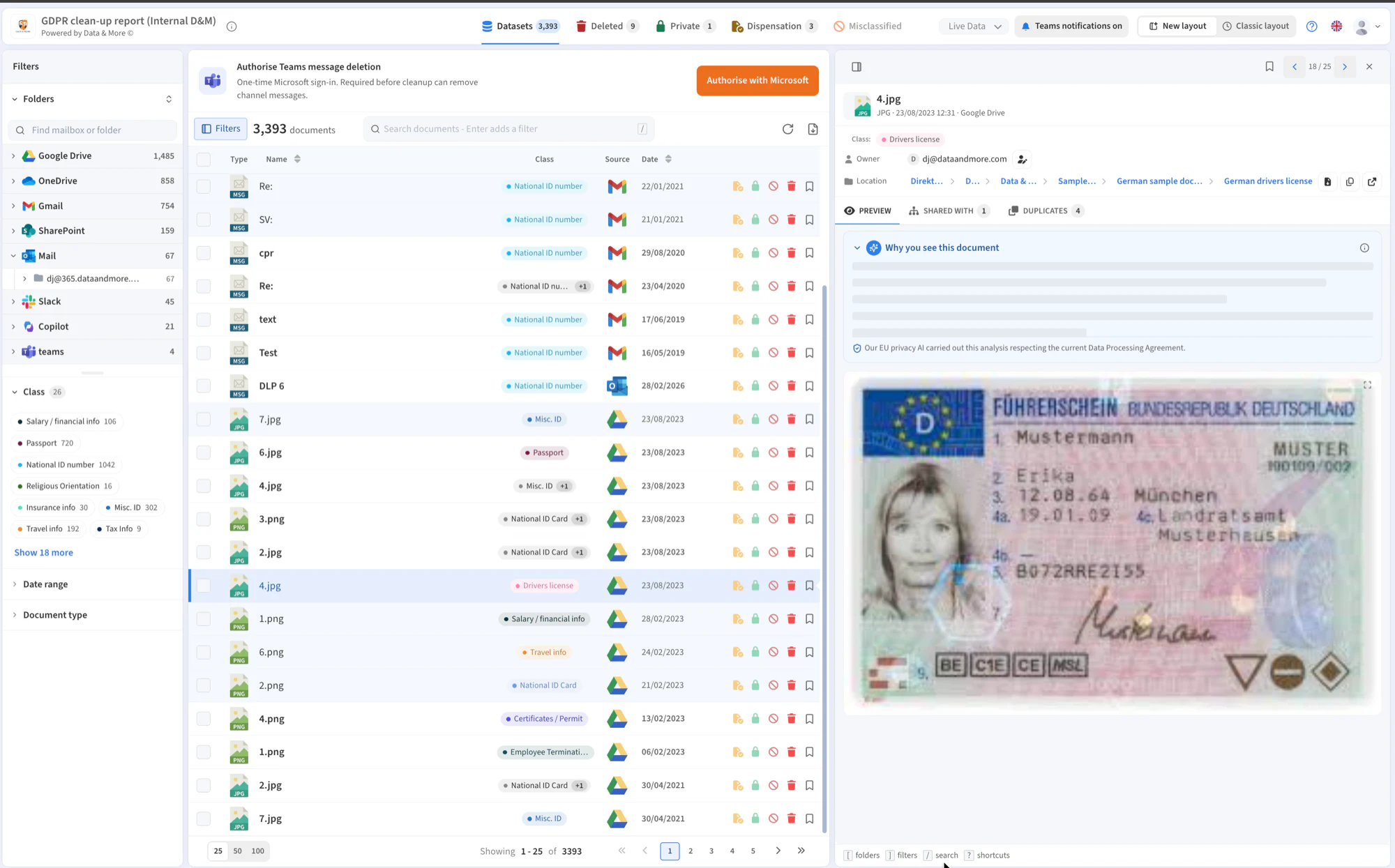
The engine
Five layers you can open up and change
Classification ships ready to use. Everything in it is still yours to adjust.
Algorithms
The detectors: pattern, semantic, OCR, face and ID recognition. Each one reports what it found and how confident it is, and each can be switched on or off per company.
Dictionaries and entry types
The vocabulary. Local unions, religious orientations, public certificates, health terms and drug names, per country. Add your own terms where your sector has words the general model does not.
Document classes
What a document is: passport, health information, CV, consent, payment card. A class is how the rest of the platform talks about a finding, from the report to the Purview label.
Tags
What should happen to it. Tags are how a class becomes an action: notify, delete, archive, redact, or leave alone.
Policies
The rules that tie it together. The policy builder composes conditions with AND and OR across class, category, creation date, document age, edited date, file size, duplicates, account and more, with revisions kept so you can see what changed.
Classification
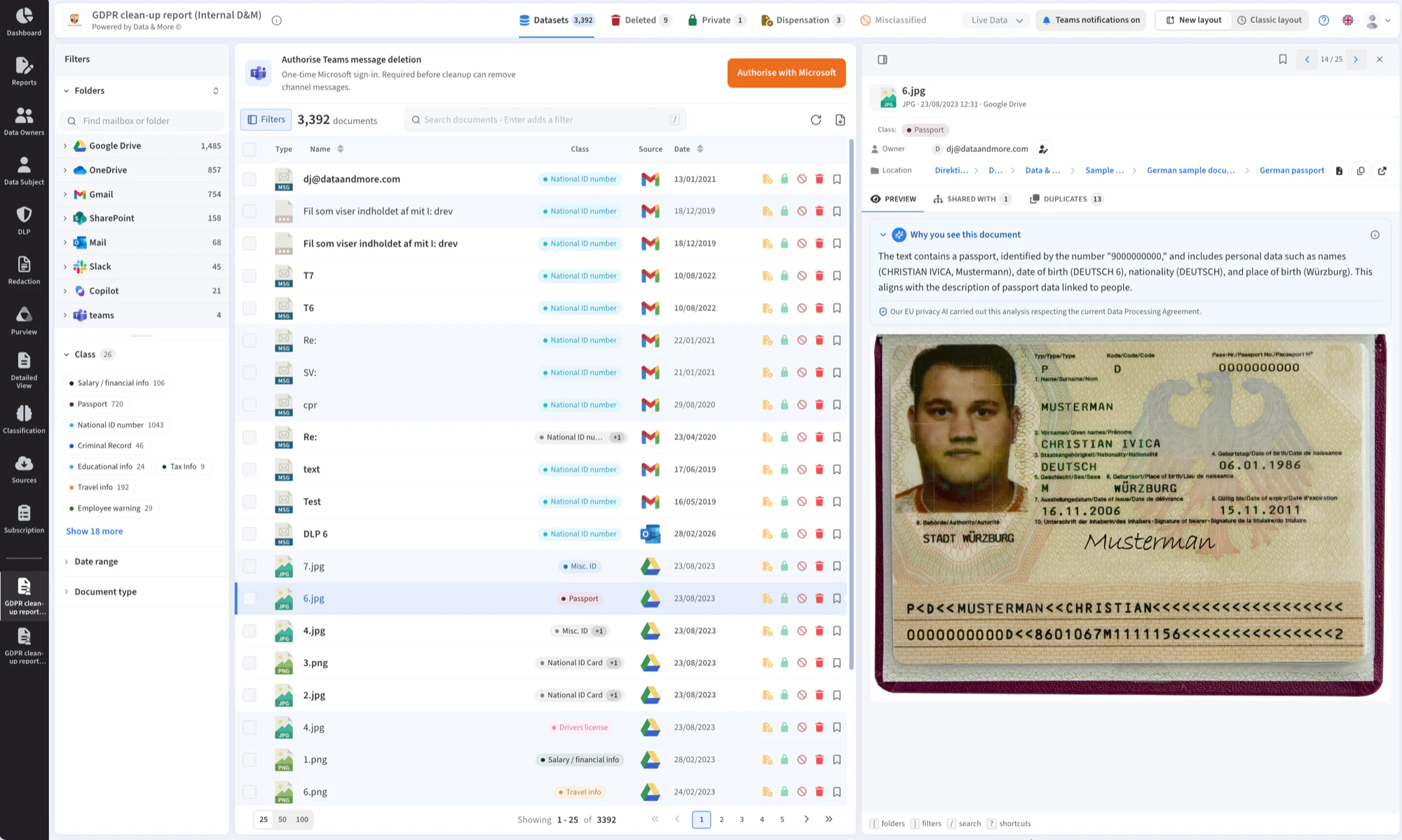
Capability
Why it finds what others miss
Semantics
Meaning, not just patterns
Complete semantic analysis rather than regex and word lists. A sentence about someone's illness is health data even when it contains no diagnosis code.
Languages
28 languages, localised
Not translation: localisation. Country-specific document classes, local unions, local certificates, local health information and drug names, built by a dedicated language team.
Images
OCR, faces and ID documents
A new OCR engine with layout detection and a fast path for passports and ID cards via the machine-readable zone, plus face recognition and a count of how many people are in a picture.
Context
Internal or external
The engine distinguishes internal communication from external, so a policy can treat a CV sent to a colleague differently from the same CV sent out of the building.
Custom
Your own classifications
Organisations with sector-specific data add their own classes and algorithms. Adding a recogniser is a small, contained change, not a product release.
Feedback
It gets better because people correct it
Every Misclassified mark from a data owner comes back as training signal. With 150,000 users across more than 50 countries, errors surface quickly and get fixed.
Nachweis
Classification in production
28
languages classified
7B
datasets monitored
0.003277%
false positive rate
25
privacy data categories
Questions about classification
How accurate is it, really?+
Do we have to configure it before it is useful?+
Can it classify scanned documents and photos?+
What about Microsoft Purview's classifiers?+
See it classify your own data
Monitor 250 mail accounts for free. The first report shows what it found and what class it gave each finding.
Start nowNo credit card required.